imagemap

Showing posts with label Math. Show all posts

Wednesday, July 26, 2023

Get Ready for a Tech-Savvy Start to School! Back-to-School Boom Card Bundles for Pre-K!

Are you looking to kickstart the new school year with exciting and interactive learning activities for your pre-K students? Look no further! Pre-K Tweets' Back-to-School Boom Card Bundles for August and September, are specially designed to engage and captivate young minds while building essential skills for their educational journey! 


Why Choose Boom Cards for Pre-K?
As technology continues to play an essential role in modern education, integrating interactive learning tools becomes increasingly vital. Boom Cards offer an innovative approach to education that combines fun with learning, making it a perfect fit for your pre-K classroom. With these digital task cards, your little learners will embark on a tech-savvy adventure while mastering key concepts.


What's Included in the bundles?
Our August and September bundles are thoughtfully curated to align with pre-K curriculum standards and are perfect for the beginning of the year! Each bundle includes a diverse selection of interactive activities like:


Llama Llama Color Sort - A great supplemental activity to the Llama Llama Red Pajama book! Reinforcing color knowledge AND classification with entertaining images and engaging game play!


Sticky Glue Alphabet -  These cards will strengthen students' early literacy skills and is a great activity to read after the story, Too Much Glue! 


Crayon Counting -  Counting and basic math concepts come to life with interactive counting and number recognition!


Mouse Shapes -  Watch as young learners identify, sort, and analyze different shapes in a playful environment!


School Supply More or Less - Students will have a blast sorting school supplies in jars and will be able to proudly compare and contrast! 

...AND MORE!  Each bundle comes with 10 learning games! 


How to download these bundles:
Visit the Pre-K Tweets TPT Shop or find us on Boom Learning website.  Browse through the August and September Boom Card Bundles. Choose the bundle that suits your pre-K classroom's needs and add it to your cart. Once you've completed the purchase, you'll receive instant access to the digital task cards, ready to be used in your classroom! (You must have Boom Learning account to access Boom Cards.)


How to set up a Boom Learning account: 

1. **Set Up an Account:** Go to the Boom Learning website and create an account. You can sign up as a teacher or school. And yes, homeschool parents and moms & dads can sign up too! 

2. **Browse and Select Decks:** Explore the Boom Card Library to find decks that align with your lesson plans and subjects. There are various topics and grade levels available.

3. **Get Decks:** You can access some free Boom Card decks, but there are also premium decks that require purchase. Add the decks you want to use to your library.

4. **Assign Decks to Students:** Once you have the decks in your library, you can assign them to your students. You can even create classes and invite students to join or share the deck's link directly. Students can get in extra practice, even from home! 

5. **Monitor Student Progress:** As students complete the Boom Card activities, you can track their progress and performance through the Boom Learning platform.


Remember that Boom Cards can complement your teaching strategies but should not replace other forms of instruction and interaction in the classroom! Boom cards on ipads are great to use in a technology learning center! 


*Note: My boom card bundles are compatible with computers, tablets, and interactive whiteboards, providing ultimate flexibility for your classroom setup! 

Thursday, September 15, 2016

Learning Centers Blog Hop Series: Math & Manipulatives Center


Welcome back to the Pre-K Partner's Learning Centers Blog Hop Series! Every other Thursday (through November) we are highlighting unique learning center ideas. This week we are going to take a look at the math/manipulatives center!


I have always had a designated "math center" in my classroom. The math center is a fun and engaging area full of hands on games, math storybooks, and manipulatives. 


This is a photo of my beginning of the year set-up for the math center. As you can see, it is pretty empty! That is because I have always introduced & integrated each and every math game/manipulative slowly into the center.  These items should always be modeled and practiced before students do them independently. You will spend less time during centers teaching students how to do the games and more time observing/documenting learning! Also, when we have showcased new center games (during group carpet/circle time) it builds up excitement and students are eager to try out the new centers. (I've always rotated centers seasonally and with the topic of study we are learning about.) 


The photo above was taken when centers were in full swing! Baskets and containers make it easy for students to collect, organize, and clean the center when finished. Because procedures were taught and reinforced so much, my assistant/nor I rarely had to ask students to straighten centers..believe it or not!  The math center contained a variety of items including:  board games, loose manipulatives, literature, vocabulary, and pocket chart games. 


The photo above was taken during our spring unit! Activities included: a bird matching game, Grouchy Ladybug book with telling time clock, a bird path/dice game, tactile number tracer boards, a flower petal numeral matching folder game, a caterpillar dice drawing game, chick number counting eggs, caterpillar graphing game, loose flower/bug manipulatives for sorting and counting, and insect/spring themed counting books. 


The math and/or manipulatives center helps students to practice math skills such as:

 - counting
- patterning
- sorting
- graphing
- measuring
- less than/more than
- number order and sequencing
- number writing/identification
- color/shape recognition
- use new math vocabulary


The center also helps students to:

- build spatial awareness
- work on fine motor skills
- practice social skills 


The math center environment and materials should include:

- a table or work space 
- shelving with easy access of materials 
- hands on games (games students can play alone, with a partner or in a small group)
- literature that relates to numbers, patterns, shapes, colors, math stories, etc.
- math vocab. (number cards, shape cards, number words)
- loose manipulatives (unifix cubes, pattern beads, pattern blocks, manipulative building toys) so students can freely count, stack, sort, and pattern with. 


Other items you might consider:

- Plastic/wooden trays & cups/bowls for game storage
- Baskets for manipulative toys and books
- Spinners (made from q-tips and paperclips)
- Dice (large, small, and some with numerals and some with number dots)
- Game pieces that are fun & unique (sea shells, mini erasers, plastic acorns, fake leaves...)
- Board games that are geared for early childhood 


- Plastic page protector sheets (for games so students can write on them with dry erase markers..great for when you don't have time to laminate...and you can store all your math games in a 3-ring binder)


The teacher's role during math/manipulatives center time (and during other center play) is to monitor, encourage, engage, observe, and document.  Teachers should monitor behavior, social interactions, and game play/manip. procedures. 


The teacher can encourage students to try out new activities. The teacher can engage students by providing a variety of fun games/manipulatives that reach students of varying skill levels. I've always tried to enhance my math center by having different games geared toward lower level, middle level, and higher level learners. I've also included a variety of games that include multiple math skills. (ex. a graphing game that includes rolling a dice, identifying number, counting, writing, etc.) 


The teacher can use this center time to observe and document student learning of new math skills. Center time is a great opportunity to see student learning in action! 


Stay tuned for more learning center fun during the Pre-K Partner's Learning Centers Blog Hop Series!

Hop on over to Fun in ECSE for more blocks learning center ideas! 


Friday, January 22, 2016

Valentine's Day

Happy Valentine's Day! ...well, almost! I ran across a few of my Valentine photos from past years as I was prepping for this year's event and thought I'd share a few... I'm so glad I rummaged through those Walmart clearance carts the day after Valentine's Day last year! I scored paper supplies and cute banner for this year. Each year we host a Valentine's breakfast and it's such a fun event! 

Students create the table centerpieces and we attach dollar store balloons to them! 
We usually start out eating our breakfast first which consists of Krispy Kreme heart donuts, tator tots, mini eggo waffles, sausage patties, and juice boxes. The hot foods are kept in a warmer on the counter. Students also enjoy fruit kabobs or fruit cups. I love having a breakfast party for Valentine's day...it's usually a much milder event and a nice change from a pizza party! 
After we eat breakfast, we play a game of Valentine Bingo. We play till everyone wins, it is pre-k after all! : ) Prizes include valentine pencils, stickers, or small trinkets. The last activity we do is usually a game or play-doh.  Last year we played a game where students raced to fill paper cups with candy hearts using chop sticks. Our homeroom mom came up with this idea and the kids loved it! This was also great fine motor practice! This year we plan to have red play-doh and heart cookie cutters/rolling pins. Our homeroom mom is making the play-doh and having parents donate the cutters. During our winter party, students ate then played games at stations. During Valentine's festivities I like to do things a little differently.  Play-doh is definitely a class favorite!


These Valentine bags were purchased at Hobby Lobby and bought during one of their discount days. Students bring their Valentine's in and place them in their own cubby. During our rest time, my aide and I fill the bags and staple them shut. With pre-k it's pretty difficult to make sure every person gets a valentine from..well..every person! I've found over the years that this way works best for my classroom..no mess..no fuss. I also pre label the bags and place them on top of their cubbies,..I can simply go down the line and fill the bags up! 
Here's another Valentine bag idea. Students watercolored paper heart doilies then glued them on their red Valentine bag. It was super cute and all the hearts looked different...

Each year the students get to make the Valentine's Day party centerpieces. I absolutely love my crayon melter! I cannot tell you where it's from. It was passed down to me and is so useful on many projects. Melted crayons are just such a different look and the kids love experimenting while swirling the colors. We use cotton q-tips to apply the melted crayons to cardstock hearts. After they dry, which takes just a few seconds, we attach the hearts to small wooden dowel rods. A couple hearts are placed in a mason jar with some filler and voila...cute centerpiece! For filler in the mason jar we've used crumpled colorful paper, tissue paper, crayons, and/or plastic beads. 


We also attach a balloon to the jar. Here's a tip: Have your students peel the crayons for the crayon melter themselves! It's a great arrival activity and helps fine motor skills! 
Here's another great fine motor activity! Yarn wrapped hearts...I bought the wire twine at Hobby Lobby. I cut all the wire about 10-12 inch lengths then bent into heart shapes and twisted them closed at the bottom. Students chose their yarn colors and wrapped and weaved to their "heart's" desire!  We hung them from the window with string..it's such a sweet keepsake and also could be used as a Christmas ornament. 
Valentines Day Broken Hearts: This is a game that could be played during your whole group math lesson or even during your party. I simply cut out construction paper hearts, wrote numeral on one side and drew matching chocolate kisses on the other. I cut the zig zags a little different on each. I scattered the broken hearts all around the room and students worked together to match them up! 

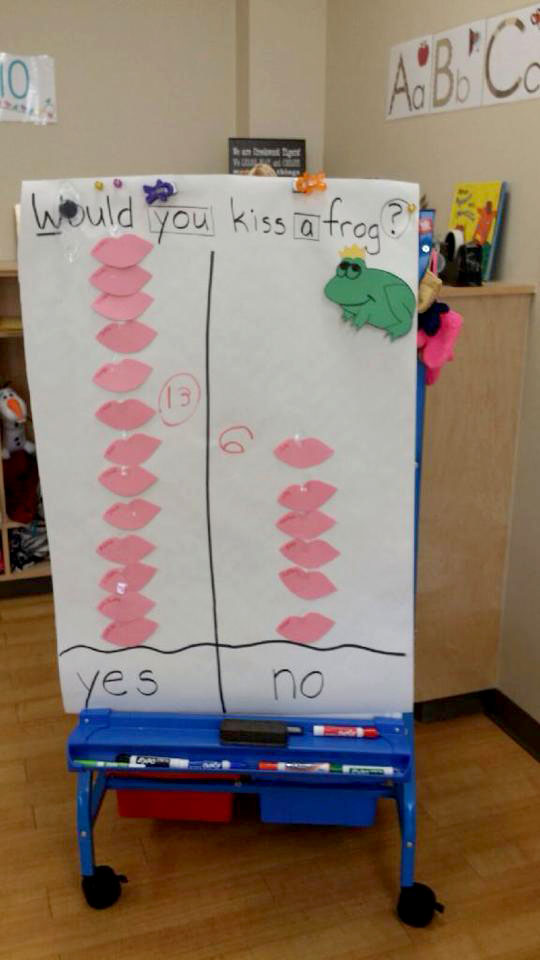
Students pucker up to the frog prince during Valentine's week! Students sit in a whole group circle and pass the frog as music is played. When the music stops..they have to pucker up! : ) : ) : ) It's a silly game and yet such a great time filler! It also is a great game for an opening activity at your Valentine's event!
Our fairy tale unit flows nicely with Valentine's week!  My students love to graph! We graph our favorite fairy tales, characters, and different versions of stories that we like best. We read a few different versions of Princess and the Frog...one of our projects was this Pucker Up! graph... There were many giggles during this math activity! The original idea for this graph came from: http://perciousperks.blogspot.com/2011/10/if-i-had-fairy-godmother.html

None of our class parties would be complete without our festive photo booth! Our pre-k assistant, Mrs. B, does a a fantastic job of decorating it to fit our themes! It's been a Seuss booth, 50's car, Christmas booth, and of course a frog kissing station! Parents LOVE receiving photos of their kiddos during the year in the photo booth...this also is a fun activity to do during your Valentine's event!  For photo props, we bought a few foam Valentine cut outs and glued them onto sticks. 


Sunday, March 1, 2015

Monday, March 10, 2014

Happy Dr. Seuss Week!

Dr. Seuss week was so much fun for our students AND teachers! Here are a few more activities we were able to incorporate.
Read about "Dr. Seuss Week part 1" here
Students decorated silly Cat in the Hat hats to their heart's content while wearing their silly hats of course! 
For journaling, students thought of funny food combinations and had to draw/share their ideas!

Silly socks were designed with dot markers for "Silly Sock Day!"  Here is the template.
Centers were transformed into Seussville for the week!  Here is a "Cat in the Hat" math game. I free handed the had outline and then drew different stripes.  I made about ten and students had to match the number of stripes to the numbered clothespin.  (matching, colors, counting, number identification, and fine motor!)
I cannot find the original source of this game and I don't take credit for it. It is a math game where a student rolls the dice, locates the number card, and then counts out fish for the bowl.  I use it during Dr. Seuss week and during our ocean unit. I love to use wooden or plastic trays to hold the games in math and ABC centers. I buy them at Hobby Lobby.
Another math game!  This is a go fish magnet game. Students use two jumbo foam dice to roll a number, add numbers together,  and search for the matching fish!  The poles are made from paintbrush sticks, yarn, and a heavy duty magnet. Click HERE or below to download some silly fish so you can create your own Go Fish game! 


"Dress like your favorite Seuss character day!"  Best dress up day yet!  This is our lovely pre-k assistant sporting a table/fish bowl combo!  She's so awesome! She even has a framed photo of Cat in the Hat on her "table."  Her fish bowl is made from a salad bowl attached to a headband/ribbon. The kids LOVED it! 
..and here are her lovely Dr. Seuss nails to theme with our week! 

Look how creative this mom was!  The fins are made of craft foam and attached to a t-shirt with safety pins! 
I love, love, love this game! I had been looking for a rhyming game easy enough for pre-k to put in ABC center. This is a truffula tree picture rhyming game.  You can purchase it here for FREE!
..and last but not least...favorite Dr. Seuss book graph I downloaded off the SMARTBOARD exchange...love that site!